Sunday, 6 October 2013

What's the difference between a Raven and a Crow?

I haven't posted anything for a while. The reason is that my parents had this great idea to refurbish our house. They had been planning to do it for years, so I didn't think it would ever happen. But a few weeks ago they told me that they would need my room for storing bricks and cement and stuff. And that's why I had to go and stay with my grandma for a while.

My grandma's a little crazy, but she's also very nice. I didn't mind living with her for a few weeks. She bakes the most amazing cakes! The only problem is that she doesn't have any broadband at her place...

Anyway. I'm back home now. My parents are almost finished (there's still lots of cement bags and bricks stored on our driveway). So I thought I should post something new...

Last week, my cousin Carl (who is a few years older than me and totally into horror stuff) told me something very strange about crows. He said that they sometimes attack people and hack out their eyes. I thought he was just trying to scare me, so I asked my dad about it. He didn't think they did. But he also couldn't explain the difference between a raven and a crow. So I got online and did a little research.


Here's what I found out: Crows and Ravens are actually all part of the same crow family called corvus. Crows are a bit smaller than ravens (pigeon size), and they are less shiny. Ravens are huge, almost as big as a falcon. But they live farer away from cities and from people, so we usually see them less.

I only ever see crows when they sit outside my window in our neighbour's garden. Sometimes there's a few flying over our house (a few crows flying together is called a 'murder of crows'- which I think is pretty cool!). It's hard to tell what they look like when they're flying. But apparently they have a very different shape of tail (which you cannot see when they are sitting down). Crows' tail feathers are fan-shaped and a raven's tail looks a little more wedge-shaped.

Another way to tell crows and ravens apart is the way they sound. A crow's call sounds a bit like an angry poodle and a raven's call sounds more like a complaining old person. Check out these videos on YouTube for an example:

Video 1: angry poodle crow


Video 2: old person raven


Crows eat almost everything they can find. Berries, little insects and also dead things. In the stories of old, people saw them after battles and such because they fed on the dead bodies and the fallen horses. I think that's why a few of them together are always considered to be a bad sign.

So - as it turns out - crows actually will hack out your eyes if you're a dead soldier lying in a ditch somewhere. They will also eat your horse. But the good thing is that they would not try and eat you while you're still alive, so there's no need to worry.

What most people don't know is that ravens also eat dead things. But they usually do it alone. Maybe that's why they're not as well known for it.


 If you want to find out a little more about crows and why they sleep together in roots, check out this informative website: http://www.birds.cornell.edu/crows/crowfaq.htm.

For some more information on crows and ravens in celtic and native American myths, you could have a look at this blog.

The picture with the crow and the pram was designed by Dark Shepard - I found it on imgfave.com. The image with the flying raven came from people.tribe.net.

Tuesday, 30 July 2013

Where does Rust come from?

Sorry for the long silence, everyone. The weather was really nice here in Britain and I spent a lot of time outside. My friends Tommy and Steve came over and my dad helped us build an awesome treehouse. We pretended to be Aliens who wanted to take over the world from up in our treehouse. Steve even invented a little lift we could use for transporting food and stuff... It was pretty cool!


We also wanted to go on a bike ride through the woods the other day. But when I got out my bike, it was pretty rusty. My parents don't have a lot of money, so they got the bike off one of my cousins when he got a new one last year. It was a very old bike, and when I got it, it already had a few rusty patches. But because we don't have anywhere to put it, I had to keep it outside over the winter (which was really cold and rainy!). And when I got it out for our bike ride the other day, the rust had gotten everywhere...!

There was rust on the chain, on the crank arm, on the handle bars, under the seat and all over the brakes. And when I tried to get it off with the sponge and the old cloth my mom gave me, one of the crossbar clamps came off in my hands and crumbled into a million pieces.

First, I got really upset because I couldn't go on the bike ride with my friends. But then I thought it might be a good idea to find out a little more about rust. Especially because my dad keeps complaining about all the rust on his old VW. He clearly has no idea how to get rid of it properly. So here it goes...


My dad calls rust the 'tin worm', but rust is a chemical reaction and not an animal. When metal rusts, it turns into a compound called 'Iron Oxide'. Iron oxide (Fe2O3) looks a bit like brown and leafy dirt (If you're a real chemistry nerd, you might want to have a look at the whole chemical formula on Chemicalformula.org). The whole process is called 'corrosion' and it happens when metal reacts with water and with oxygen (air). (Check out a few cool experiments with different oxygen levels and rusty steel wool on Physicsinsights.com here.)

Rusting is actually pretty cool. It is a full-on electrochemical process. The metal acts as an anode and the water as the electrolyte of the reaction (check out this video on YouTube for an introduction into electrolytes). When the oxygen in the water reacts with the metal, electrons are set in motion - which then flow to the cathode and convert the metal into rust (the metal also expands - which explains the flaky bits). If you're living close to the sea, sea water makes things even worse because it's got a lot of salt in it. (Higher salt levels make for better electrolyte action.)

Because water and air are pretty much everywhere, it turns out that the only way to prevent metal from rusting is to keep it in a vacuum or to coat it with lots of paint or with corrosion inhibitors. You can also 'galvanize' it with a special zinc coating (they do this with cars). But there are some more advanced techniques that can be used for corrosion protection.

On offshore oil platforms, big oil companies use something called Cathodic Protection to keep their steel from rusting. Instead of letting the structure rust, cathodic protection uses a fake bit of metal as a cathode. Once the first layer is fully covered with rust, it can then protect the rest of the metal because it creates a separate electro-chemical cell. This method is also used in storage tanks and home heating systems. But I don't think it will work on my bike or on my dad's VW because I don't think he will want to drive around in a car that's totally covered in rust...

If my parents had more money, I would ask them to buy me a bike with a full aluminum frame. Some people think aluminum can't rust but that's wrong. It does. But when it does, the rust on top looks a lot like the original aluminum because it's grey. It acts as a natural galvanizer and protects the surface from further corrosion.

I think I will have to sand off the rust on my bike and then put some zinc primer (which is a lighter version of cathodic protection) and some paint on it. This is also what my dad should do with his VW. I hope he has one of those masks people use for painting because some of the stuff I found online seems pretty potent. I don't think he should do this alone. He's not very good with technical things and I don't want him to go blind or faint...


The alien picture came from a website called Sodahead.com. The VW picture is from a project I found on TheSamba.com. The oil platform came from a website on rust protection and anti-corrosion paints www.aquasteel.co.uk).

Sunday, 30 June 2013

Why do we cry?

Yesterday my mom told me that my dad is not my real dad. She showed me pictures of my real dad and she told me what a loser he was. Then she cried a lot and said she was sorry she couldn't tell me any sooner.


I like my stepdad. As far as I'm concerned, he's still my real dad. We have lots of fun together. I don't know my biological dad, but I'm sure he can be nowhere near as nice as my stepdad. Especially considering that he left me and my mom and ran off with another woman.

So when my mom asked me if I wanted to meet my real dad sometime, I said no. I don't want things to become complicated between me and my stepdad. And I also don't want things to become weird and awkward just because there's some other dad on an old photograph. I like things very much the way they are.

But the whole thing made me realize something else. My mom almost never cries. She's one of those people who think that 'keeping a stiff upper lip' is more than just a saying. I never understood what 'keeping a stiff upper lip' really means. I think that people would look very weird if they were to do it properly.


My mom says it has to do with manners. And that's why she's always pulling herself together so much. (Have a look at this article in the Telegraph to find out a little more about British stiff-upper-lipness.)

Anyway. When she showed me those pictures of my dad, I thought it was strange how she lost a bit of her stiff upper lip. I had never seen her cry before. I think it had to do with my other dad running off with that woman. But I also thought it would be best not to ask her any more questions. I know that crying makes her feel very uncomfortable.

I'm sure my mom will tell me more about my other dad when she's ready. So - in the meantime - I wanted to find out why sad memories can make us cry so much. And I also wanted to know what tears are really made of. So here it goes...

Tears are very interesting because they're always there, even in our sleep. They are made out of mucus, water and oil, and our body produces them to keep our eyes lubricated and clean. The mucus in the middle part consists of a lot of proteins, then there's a layer of watery minerals, antibodies and vitamins. The antibodies and vitamins are there to keep the eye fresh and healthy. The outside of each tear consists of an oily substance called meibum (which sounds a lot like 'my bum'). This keeps our eyes from drying out too quickly.


Biologists distinguish between three different types of tears. These are basal tears, reflex tears and psychic or emotional tears. The basal tears are the ones that are always there to protect the eye. When we blink, they get washed out of something called the lacrimal punctum. It's a pretty interesting process because every time we blink we also wash out the old layer of tears through something called the inferior lacrimal canal. It's a little tunnel that transports our old tears through to our nose. (Check out this image on Wikipedia for a detailed description of the tear system in our eyes.)

Our reflex tears are the ones we shed when we've got something in our eye (such as a hair or dust). They are also the reason we get so teary every time someone cuts an onion. Onion vapors are really irritant for our eyes, so our eyes try to wash away the sulfenic acids they produce by generating more and more teary lubricant. (If you're into chemistry, you'll be interested to know that the sulfenic acid of an onion is turned into a special kind of sulfenic acid named 1-propenesulfenic acid, which then reacts with an enzyme to create syn-propanethial-S-oxide. Click on the link for a full description of this and to see what it looks like).

But I think the third type of our tears is the most interesting one. When we cry because we're sad or emotional, we activate all kinds of physical reactions. Reflex tears and basal lubrication of the eyes is pretty straightforward. But when we have emotional stress or when we feel fear, our limbic system, our whole muscular system and our brain get involved. (It's actually not the whole brain but only a little part called 'hypothalamus' that gets involved - click here if you're interested in learning more about the hypothalamus and how it functions.)


This is why emotional tears are a bit different from normal tears. Sad tears make the body release endorphines (endorphines make us happy). But they also have a lot more hormones in them. When we cry, it's easier to calm ourselves down because our tears can regulate our hormone levels (they get rid of one special hormone called Corticotropin in particular.) Some people cry when they're happy in order to release some of the joy they feel. But crying always has a social function as well. When we cry, we want others to see what we feel inside. And this might help them to help us get better.

Before I ask my mom some more questions, I think I'll have to tell her that it's OK to cry. You don't always have to keep a stiff upper lip. Scientists say crying helps to calm ourselves (I even found a blog on a site called Psychcentral that's called 'Seven Good Reasons to Cry'). It tells others about our difficulties and it strengthens our social ties. So it's OK for my mom to feel sad that our first dad left us for another woman. There's nothing wrong with that.

And while I'm on it, I will also tell my (step)dad. He still thinks that men don't cry. But I've seen him fall apart every time he watches a romantic comedy...

Check out this video I found on psychic crying by the 'Talk Nerdy To Me' guys. It's pretty interesting.


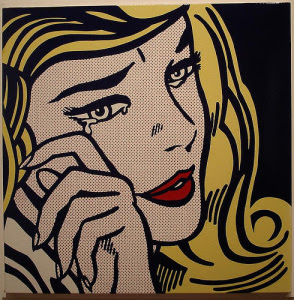
I took the small picture of the crying woman from a blog called Science inspiration. The stiff upper lippy picture came from the article on stiff upper lips on the Telegraph's website. The crying girl picture at the beginning of my post was made by Roy Lichtenberg in 1964. 

The crying boy was photographed by someone called Jill Greenberg. I found him on a blog post praising her work on reelphoto.blogspot.co.uk.