My dad and I went to the zoo last week. My dad and my mum are getting a divorce, so he's trying to spend more time with me. He's moved out of the house and now lives in a small flat in the city. I think my parents' separation is a little crazy. Especially after they've refurbished most of our house together. But lots of my friends have divorced parents, so I understand that they are no longer getting along. Maybe it's because of all the crazy refurbishing? The good thing is that I get to spend most weekends with my dad. The rest of the week I'm with my mum. The whole divorce thing is also why I haven't been able to post anything in a while ...
Anyway. My dad and I went to the zoo last week and I checked out the tigers. They had a few cubs and they were pretty amazing! But I like the bears more, so we went to see them. The zoo keeper in charge of the bears told us that they were hibernating. I didn't know that bears could hibernate even when they're kept in zoos. But my dad said it's in their nature. I wanted the zoo keeper to tell me a little more about hibernation, but he was in quite a hurry. So I went online and did a little research...
It turns out that bears are not the only animals that hibernate. A lot of other animals do as well. During hibernation, animals do more than just sleep through the cold, though. I found out that they can lower their body temperature, slow their breathing and lower their heart rate. I think that's pretty cool! There are even some fish that go dormant when they need to, and there's one special type of bird called Common Poorwill that hibernates in California. A few lemurs, bats and mice do also hibernate. Check out this website for a more comprehensive list of hibernating animals.
When bears hibernate, they still consume about 4,000 calories per day. This is quite a lot, considering that humans only need 2,000. But it's nothing for a grown bear - they can eat up to 20,000 calories when they're preparing for hibernation. Bears usually hibernate from 5 to 7 months a year, depending on where in the world they live and how much food there is. Once they're in their hibernating state, they only need to breathe every 45 seconds or so. Their heart rate can lower to as low as 8 beats per second, and they can reduce their normal blood flow to 45%!
Polar bears only hibernate when they're giving birth. They dig a whole in the snow, disappear for three months and live off their fat reserves. The problem is that the more they lose their natural environment because of climate change, the less they can eat and build up fat for giving birth. The result is less and less polar bear cubs! I thought that was quite depressing ... It's "Raise your Paw for Polar Bears" for Greenpeace this week, so maybe we can all help via #raiseyourpaw.
I also found out that bears in captivity normally don't hibernate. Our zoo has a huge outdoor enclosure for its bears, so maybe that's why they still do sleep for quite some time. Or it's because the zoo wants them to keep up their normal and instinctive behaviour. I'll have to ask the zoo keeper next time we're there...
I took the sleeping King Julian image from the Madagascar Wiki. The picture about the divorce came from a lawyer's website. The awesome sleeping bear came from the Times' website. The cute polar bear cub is from firstpeople.us/.
One of my aunts lives by the sea. Because it is such a hot summer this year, we went and visited her last weekend. My mom said, she needed some time away after all the house refurbishment she had to do with my dad over the past few months.
My aunt loves sheep and she keeps a few of them in her back garden. (She lives on a small farm, so her back garden is a little bigger than ours). The sheep seemed pretty hot, so I asked her if she knew if they were sweating a lot in summer. She didn't know, so I went online and did a little research...
I think sheep are pretty cool. They're always hungry, their poo is not as smelly as cow dung or dog poo; and when they baa, they sound a lot like the horn of my dad's old camper van. But there are a few more reasons why I think sheep are so great.
Our Geography teacher told us that there are three times more sheep in Wales than people. Wales has about 3 million inhabitants, so that would mean there are more than 9 million sheep in Wales. (There are only a few more sheep than people in Scotland, in case you're interested - check out the Scottish Government's site on sheep to find out more). Most sheep live in China (144 million). When they're together, they are called a 'flock'. They can produce lactose free cheese (which is very good news for people like my dad - if you want to know why, you should check out my post on lactose intolerant people). The first mammal scientists could clone was also a sheep. It was called Dolly and lived a very happy life (or so they say) in Edinburgh until it died in 2003 (you can find out more about Dolly on this site called Animal Research).
But the coolest fact about sheep is that they're so white and fluffy and that their wool can be used for all kinds of fascinating things. If you're a vegan, you won't be interested in this. But sheep can produce sheep wool insulation for your house and their wool can keep you very warm in winter. The sheep hair that goes into the wool grows in waves which are called 'crimp'.
I also found out that sheep don't get wet because of Lanolin. Lanolin is sometimes called 'wool grease' and it is what keeps sheep dry in Winter. The grease can be extracted from shorn wool and used for waterproofing. (You can find out more about Lanolin by checking out the Wikipedia article. And you can click here for some more cool facts on sheep and on wool production in the UK).
Anyway. It turns out that sheep actually do sweat a lot because they have sweat glands. Apparently, they also become very smelly if they do. Sheep get shorn just before summer or before they have to 'go into housing' in winter. Their wool keeps them so warm inside or during the hot months of summer that it would be way too hot for them otherwise. The best thing to do when they start sweating is to shear them then. And since they're letting us have all their wool and grease, I think we should all be very friendly towards them and appreciate them a bit more when we see them.
The picture of the sheep by the sea was taken by Sam_CH and can be found on trekearth.com. The derelict house came from the Guardian's website. The sheep with the camera is from a website called cartmel-sheepyvillage.com.
My grandma died last week. On Thursday, my mom got a call from a nurse and then she cried. I wasn't quite sure what to do. But my mom said that it was important she got some flowers. At my grandpa's funeral a few months before, she didn't bring any, and her sisters started to make fun of her. I thought that was pretty ugly...
I liked my grandma. I still haven't cried or anything. But I've been thinking about her a lot. We used to visit her when I was little. I spent some of my summer holidays with her. I remember that she had a drawer with all kinds of fancy chocolate...
One day, the police found her outside her house eating her lawn. She hit one of them when he tried to pull her away and that was when they realized she was a little crazy. My aunt had her put in a mental institution. I always thought it was a bit odd to hospitalize someone just because they were eating grass. But my mom later told me that it wasn't just the grass. Grandma had some sort of schizophrenia. (If you want to find out a little more about schizophrenic people, check out this helpful website). I think my uncle also suffers from it; although he never tried to eat the grass in front of his house (check out my post on the number 13 in case you want to know more about my strange Uncle Herbert).
Anyway. All this thinking about my grandma made me realize that no one has ever explained to me why people shouldn't eat grass. My friend Steve thinks it's because people are told not to (Steve has a few crazy ideas, but he's a genius inventor. You should read up on what he said in Sunday school a few months ago).
I didn't believe he was right, so I did a little research... First I tried some of the grass in front of our house. It was awful!! I think the grass we have isn't meant for eating at all! My teeth turned green and my mom thought I was going crazy too. I also got a horrible stomach ache and had to fart like crazy for the rest of the day...
The sheep seem to like it. And so do the cows. But that's only because they can digest the grass much better than we can. People can actually eat grass. It's not toxic or anything. But it doesn't do them any good because they can't digest it. Cows and sheep are ruminating animals. They have several stomachs and they ferment the grass before it gets to their main digestive system. (Check out this Wikipedia image for some funny names and a cool example of a 'ruminant stomach').
There is also another problem with eating grass (if you're not a cow or a sheep). Grass contains an awful lot of silica. Silica is an abrasive macromolecule that can be found in sand and glass. This means that your dentist wouldn't want you eating grass because it will grind down your teeth. Cows and sheep can grow new ones in case this happens. But humans can't. (For all the chemistry freaks: silica is actually silicon dioxide. Check out this interesting blog to find out a bit more on its use and where it comes from. You can also find out some more info about its chemical structure on www.green-planet-solar-energy.com).
As it turns out, my grandma actually was a little crazy when she tried to eat the grass. But I don't think that was the real reason why she was put in a mental home. I miss her a lot. I also found out that there are quite a lot of other crazies who eat grass from time to time. Check out this article from the Daily Mail, for example. It's about a South African preacher who made his congregation eat grass so they could be 'closer to God'. Now - how is that for crazy?
If you want to read a little more about religious fanatics, you can have a look at my post on 'So, when was God invented, then?'. For more information on grass eating, you should have a look at this short article on www.livescience.com. In case you are looking for help with schizophrenia or for more info, check out this NHS site.
I took the flower picture from the Telegraph's website. The sheep came from a New Zealand website on sheep and farming called www.teara.govt.nz. I found the silicon dioxide structure on www.green-planet-solar-energy.com and the crazy religious fanatic came from the Daily Mail article.
Most people I know don't like rubbish very much. They think it's smelly and ugly and they don't want anything to do with it. They also don't like the rubbish men. My granddad says they're all gypsies and foreigners. I should mention that my granddad is not a very nice person. He sometimes goes on rants for a whole day. He also says rubbish men smell like the work they do.
I think rubbish men are great (although I don't mention this to my granddad). Their job is really smelly and dirty, but they are very efficient and leave empty rubbish bins for people to put more rubbish in. Their trucks are pretty cool too. I once got to ride on one of them and thought it was awesome! (My mom thought I had been kidnapped and got really angry with me. I was grounded for a week, but it was well worth it...)
Anyway. I think it's pretty amazing that rubbish trucks can load such an enormous amount of rubbish, so I wanted to find out how they do it. I also wanted to know where the rubbish goes. I know that my mom is still a bit angry with me for getting onto the truck, so asking her was out of the question.
I did a little research instead.
It turns out there are quite a few different types of rubbish truck. Not all of them are in use in the UK, but they are all pretty cool. ASL ones (automated side loaders) pick up your rubbish right from the sidewalk, and they just need one driver who also operates the system. Then there's normal container ones you'd normally use for skip hire, and front loaders (FEL). Grapple or Clam trucks can pick up small stuff from the side of the road, and rear loaders (REL) come with a nice automated press (or compactor) at the end.
The most common 'refuse' truck (that's how you would call rubbish if you're posh) in our country is probably the DENNIS Elite or Eagle Elite (that's the one in the picture). It's yellow or orange and comes as a medium sized side or rear loader.
Check out this video I found on the different types of trucks (mostly US trucks- but still very cool):
A normal rubbish truck can hold anything between 12 and 14 tons of rubbish. I think that's quite a lot. Especially cause the rubbish men have to stop at around 800 houses to fill it all up. The compactor at the end compresses the rubbish into tiny packages (or cuts it to bits - depending on the type) and then slides them back into the main body of the truck.
At the landfill, the rubbish gets emptied, further compressed and filled in, burned or recycled. In the UK, we have already filled 109 square miles with it. I think that's way too much! Our biology teacher says it's about time we all did a bit more recycling if we want to save the planet...
My parents think it's a bit strange that my favourite day of the week is rubbish day. But I think we should all be a bit more friendly with our rubbish men. Most people only know that rubbish needs to be put out on a Thursday (at least in our council area). But they never really want to know where it goes...
There are lots of amazing things people can do with rubbish, and some rubbish can be quite useful. If you want to find out more about this and how to re-use stuff other people throw away (it's called 'upcycling), then check out this cool makers' website: www.floweringelbow.org.
If you want to know more about the different types of recycling in your area, click here. You can also read up on recycling and how to reduce your rubbish with wasteonline.org.uk.
I took the recycled earth image from an Australian Unilodge website, the rubbish truck pic came from Trucktrader. The gypsy woman was painted by an unknown Polish painter and can be found on Wikipedia.
I haven't posted anything for a while. The reason is that my parents had this great idea to refurbish our house. They had been planning to do it for years, so I didn't think it would ever happen. But a few weeks ago they told me that they would need my room for storing bricks and cement and stuff. And that's why I had to go and stay with my grandma for a while.
My grandma's a little crazy, but she's also very nice. I didn't mind living with her for a few weeks. She bakes the most amazing cakes! The only problem is that she doesn't have any broadband at her place...
Anyway. I'm back home now. My parents are almost finished (there's still lots of cement bags and bricks stored on our driveway). So I thought I should post something new...
Last week, my cousin Carl (who is a few years older than me and totally into horror stuff) told me something very strange about crows. He said that they sometimes attack people and hack out their eyes. I thought he was just trying to scare me, so I asked my dad about it. He didn't think they did. But he also couldn't explain the difference between a raven and a crow. So I got online and did a little research.
Here's what I found out: Crows and Ravens are actually all part of the same crow family called corvus. Crows are a bit smaller than ravens (pigeon size), and they are less shiny. Ravens are huge, almost as big as a falcon. But they live farer away from cities and from people, so we usually see them less.
I only ever see crows when they sit outside my window in our neighbour's garden. Sometimes there's a few flying over our house (a few crows flying together is called a 'murder of crows'- which I think is pretty cool!). It's hard to tell what they look like when they're flying. But apparently they have a very different shape of tail (which you cannot see when they are sitting down). Crows' tail feathers are fan-shaped and a raven's tail looks a little more wedge-shaped.
Another way to tell crows and ravens apart is the way they sound. A crow's call sounds a bit like an angry poodle and a raven's call sounds more like a complaining old person. Check out these videos on YouTube for an example:
Video 1: angry poodle crow
Video 2: old person raven
Crows eat almost everything they can find. Berries, little insects and also dead things. In the stories of old, people saw them after battles and such because they fed on the dead bodies and the fallen horses. I think that's why a few of them together are always considered to be a bad sign.
So - as it turns out - crows actually will hack out your eyes if you're a dead soldier lying in a ditch somewhere. They will also eat your horse. But the good thing is that they would not try and eat you while you're still alive, so there's no need to worry.
What most people don't know is that ravens also eat dead things. But they usually do it alone. Maybe that's why they're not as well known for it.
For some more information on crows and ravens in celtic and native American myths, you could have a look at this blog.
The picture with the crow and the pram was designed by Dark Shepard - I found it on imgfave.com. The image with the flying raven came from people.tribe.net.
Sorry for the long silence, everyone. The weather was really nice here in Britain and I spent a lot of time outside. My friends Tommy and Steve came over and my dad helped us build an awesome treehouse. We pretended to be Aliens who wanted to take over the world from up in our treehouse. Steve even invented a little lift we could use for transporting food and stuff... It was pretty cool!
We also wanted to go on a bike ride through the woods the other day. But when I got out my bike, it was pretty rusty. My parents don't have a lot of money, so they got the bike off one of my cousins when he got a new one last year. It was a very old bike, and when I got it, it already had a few rusty patches. But because we don't have anywhere to put it, I had to keep it outside over the winter (which was really cold and rainy!). And when I got it out for our bike ride the other day, the rust had gotten everywhere...!
There was rust on the chain, on the crank arm, on the handle bars, under the seat and all over the brakes. And when I tried to get it off with the sponge and the old cloth my mom gave me, one of the crossbar clamps came off in my hands and crumbled into a million pieces.
First, I got really upset because I couldn't go on the bike ride with my friends. But then I thought it might be a good idea to find out a little more about rust. Especially because my dad keeps complaining about all the rust on his old VW. He clearly has no idea how to get rid of it properly. So here it goes...
My dad calls rust the 'tin worm', but rust is a chemical reaction and not an animal. When metal rusts, it turns into a compound called 'Iron Oxide'. Iron oxide (Fe2O3) looks a bit like brown and leafy dirt (If you're a real chemistry nerd, you might want to have a look at the whole chemical formula on Chemicalformula.org). The whole process is called 'corrosion' and it happens when metal reacts with water and with oxygen (air). (Check out a few cool experiments with different oxygen levels and rusty steel wool on Physicsinsights.com here.)
Rusting is actually pretty cool. It is a full-on electrochemical process. The metal acts as an anode and the water as the electrolyte of the reaction (check out this video on YouTube for an introduction into electrolytes). When the oxygen in the water reacts with the metal, electrons are set in motion - which then flow to the cathode and convert the metal into rust (the metal also expands - which explains the flaky bits). If you're living close to the sea, sea water makes things even worse because it's got a lot of salt in it. (Higher salt levels make for better electrolyte action.)
Because water and air are pretty much everywhere, it turns out that the only way to prevent metal from rusting is to keep it in a vacuum or to coat it with lots of paint or with corrosion inhibitors. You can also 'galvanize' it with a special zinc coating (they do this with cars). But there are some more advanced techniques that can be used for corrosion protection.
On offshore oil platforms, big oil companies use something called Cathodic Protection to keep their steel from rusting. Instead of letting the structure rust, cathodic protection uses a fake bit of metal as a cathode. Once the first layer is fully covered with rust, it can then protect the rest of the metal because it creates a separate electro-chemical cell. This method is also used in storage tanks and home heating systems. But I don't think it will work on my bike or on my dad's VW because I don't think he will want to drive around in a car that's totally covered in rust...
If my parents had more money, I would ask them to buy me a bike with a full aluminum frame. Some people think aluminum can't rust but that's wrong. It does. But when it does, the rust on top looks a lot like the original aluminum because it's grey. It acts as a natural galvanizer and protects the surface from further corrosion.
I think I will have to sand off the rust on my bike and then put some zinc primer (which is a lighter version of cathodic protection) and some paint on it. This is also what my dad should do with his VW. I hope he has one of those masks people use for painting because some of the stuff I found online seems pretty potent. I don't think he should do this alone. He's not very good with technical things and I don't want him to go blind or faint...
The alien picture came from a website called Sodahead.com. The VW picture is from a project I found on TheSamba.com. The oil platform came from a website on rust protection and anti-corrosion paints www.aquasteel.co.uk).
Yesterday my mom told me that my dad is not my real dad. She showed me pictures of my real dad and she told me what a loser he was. Then she cried a lot and said she was sorry she couldn't tell me any sooner.
I like my stepdad. As far as I'm concerned, he's still my real dad. We have lots of fun together. I don't know my biological dad, but I'm sure he can be nowhere near as nice as my stepdad. Especially considering that he left me and my mom and ran off with another woman.
So when my mom asked me if I wanted to meet my real dad sometime, I said no. I don't want things to become complicated between me and my stepdad. And I also don't want things to become weird and awkward just because there's some other dad on an old photograph. I like things very much the way they are.
But the whole thing made me realize something else. My mom almost never cries. She's one of those people who think that 'keeping a stiff upper lip' is more than just a saying. I never understood what 'keeping a stiff upper lip' really means. I think that people would look very weird if they were to do it properly.
My mom says it has to do with manners. And that's why she's always pulling herself together so much. (Have a look at this article in the Telegraph to find out a little more about British stiff-upper-lipness.)
Anyway. When she showed me those pictures of my dad, I thought it was strange how she lost a bit of her stiff upper lip. I had never seen her cry before. I think it had to do with my other dad running off with that woman. But I also thought it would be best not to ask her any more questions. I know that crying makes her feel very uncomfortable.
I'm sure my mom will tell me more about my other dad when she's ready. So - in the meantime - I wanted to find out why sad memories can make us cry so much. And I also wanted to know what tears are really made of. So here it goes...
Tears are very interesting because they're always there, even in our sleep. They are made out of mucus, water and oil, and our body produces them to keep our eyes lubricated and clean. The mucus in the middle part consists of a lot of proteins, then there's a layer of watery minerals, antibodies and vitamins. The antibodies and vitamins are there to keep the eye fresh and healthy. The outside of each tear consists of an oily substance called meibum (which sounds a lot like 'my bum'). This keeps our eyes from drying out too quickly.
Biologists distinguish between three different types of tears. These are basal tears, reflex tears and psychic or emotional tears. The basal tears are the ones that are always there to protect the eye. When we blink, they get washed out of something called the lacrimal punctum. It's a pretty interesting process because every time we blink we also wash out the old layer of tears through something called the inferior lacrimal canal. It's a little tunnel that transports our old tears through to our nose. (Check out this image on Wikipedia for a detailed description of the tear system in our eyes.)
Our reflex tears are the ones we shed when we've got something in our eye (such as a hair or dust). They are also the reason we get so teary every time someone cuts an onion. Onion vapors are really irritant for our eyes, so our eyes try to wash away the sulfenic acids they produce by generating more and more teary lubricant. (If you're into chemistry, you'll be interested to know that the sulfenic acid of an onion is turned into a special kind of sulfenic acid named 1-propenesulfenic acid, which then reacts with an enzyme to create syn-propanethial-S-oxide. Click on the link for a full description of this and to see what it looks like).
But I think the third type of our tears is the most interesting one. When we cry because we're sad or emotional, we activate all kinds of physical reactions. Reflex tears and basal lubrication of the eyes is pretty straightforward. But when we have emotional stress or when we feel fear, our limbic system, our whole muscular system and our brain get involved. (It's actually not the whole brain but only a little part called 'hypothalamus' that gets involved - click here if you're interested in learning more about the hypothalamus and how it functions.)
This is why emotional tears are a bit different from normal tears. Sad tears make the body release endorphines (endorphines make us happy). But they also have a lot more hormones in them. When we cry, it's easier to calm ourselves down because our tears can regulate our hormone levels (they get rid of one special hormone called Corticotropin in particular.) Some people cry when they're happy in order to release some of the joy they feel. But crying always has a social function as well. When we cry, we want others to see what we feel inside. And this might help them to help us get better.
Before I ask my mom some more questions, I think I'll have to tell her that it's OK to cry. You don't always have to keep a stiff upper lip. Scientists say crying helps to calm ourselves (I even found a blog on a site called Psychcentral that's called 'Seven Good Reasons to Cry'). It tells others about our difficulties and it strengthens our social ties. So it's OK for my mom to feel sad that our first dad left us for another woman. There's nothing wrong with that.
And while I'm on it, I will also tell my (step)dad. He still thinks that men don't cry. But I've seen him fall apart every time he watches a romantic comedy...
Check out this video I found on psychic crying by the 'Talk Nerdy To Me' guys. It's pretty interesting.
I took the small picture of the crying woman from a blog called Science inspiration. The stiff upper lippy picture came from the article on stiff upper lips on the Telegraph's website. The crying girl picture at the beginning of my post was made by Roy Lichtenberg in 1964.
The crying boy was photographed by someone called Jill Greenberg. I found him on a blog post praising her work on reelphoto.blogspot.co.uk.
My dad recently found out he's lactose intolerant. Whenever he has milk or anything with cream in it, he has what he calls a 'major arse explosion'. I don't think his arse actually explodes, but the smell coming from the loo is always pretty bad. And when he's done, he's usually pretty exhausted.
My mom thinks he's been lactose intolerant for years and just didn't realize. My dad was not too bothered about his angry farts. But my mom got pretty upset with him at some point and that's why she put him on a non-dairy diet. For two weeks, he could only eat stuff without any milk or cream in it; she didn't even allow him to have milk chocolate. And when he finally started drinking milk and eating cheese again last Saturday, things became really, really bad...
My mom's not lactose intolerant. She can have whatever she wants, normally it's lots of creamy cakes and nougat chocolates. I know no one in school with lactose problems, and I am not intolerant either. So I was wondering why only some people have 'arse explosions' and others don't.
I found out that lactose is a special kind of sugar that only occurs in dairy products. (If you're into chemistry, you might like to know what it looks like, so check out this picture of its full chemical structure on Wikipedia). Lactose is a part of all kinds of milk produced by mammals. This means that it's also found in human breast milk.
The real problem with it is that it needs to be broken down into glucose by our bodies. And this can only be done by a special enzyme called Lactase. Lactase is normally produced in our small intestines (that's where the first part of digestion happens). It breaks down lactose into glucose so that our body can absorb it via the bloodstream.
If you can't produce lactase, lactose apparently goes right through you and ends up in your colon. Our colon can't absorb the lactose without lactase. So it just starts working on it with the bacteria it has. And this can become very messy because it will produce huge amounts of acids, carbon dioxide, hydrogen and methane.
Anyway. The NHS has a very good site on lactose intolerance. You can check it out here. It says that there are two different types. One is called 'primary lactase deficiency', the other one is 'secondary lactase deficiency'. The first one is inherited, the second one is what you have if there is something wrong with your intestines. Most people inherit lactose deficiencies from their parents though. I found out that it can sometimes take really long until you notice it. Which would explain why my dad thought he was normal, although he smelled like a monster every time he let one rip.
Babies are immune because they produce huge amounts of lactase throughout the first two years of their lives (unless they have a problem with breast milk right away). But the gene responsible for lactose intolerance (the LCT gene) is usually passed on by parents who have at least one mutation of a gene called MCM6. (Check out this governmental website on genetics to learn more about genetic mutations in relation to lactose intolerance).
What this means is that - although only one of my parents is actually lactose intolerant - it might still be enough for me to get some major arse explosions in the future...!
My dad took me to see Star Trek- Into Darkness on Saturday. My mom only likes old movies with Romans in sandals or newer ones with Sean Connery in them, so we left her at home for this one. My dad's more into Star Wars than into Star Trek. But that's OK. Maybe it's because he always looks a little like Chewbacca if he doesn't shave for a while.
The film was in 3D and we had to buy a new pair of 3D glasses with our tickets (check out the Guardian's archive for an early review of its 3D quality here). I don't like 3D that much because it's always a bit darker and it feels like watching something through an aquarium. I have to wear glasses (because my parents don't trust me with contacts), so I have to wear my normal glasses under the 3D ones. And wearing two pairs of glasses for two hours makes my nose hurt.
Anyway. The film was alright, I thought. I liked Spock and Khan the most. My favourite scene was when Khan single-handedly took out a whole bunch of Klingons on Kronos. But I kept wondering why we had to watch it in 3D. I mean, there should really be a 2D alternative. Or a 4D one.
When we got home, I did a little research. I wanted to know how 3D glasses worked and if there was any way round them in a 3D film. I also wanted to know if 4D was an option for the next Star Trek film. This is what I found:
3D movies are projected onto the big screen twice, so what you see is actually two different sets of film. The glasses they give you then separate the pictures so that each eye only gets one picture each. (This is done by polarized films in the glasses. The two films are projected in a 45 and in a 135 degree angle. You can find out more about angles and on polarized films on mentalfloss.com here.) In the old days, cinemas used two different projectors to get the two pictures on screen. Nowadays, only one projector is used. The new projectors now use a system called RealD, which separates light rays in spirals. But the 3D effect itself has been around since 1936.
Check out RealD's website for a bit more information on those new projectors.
There are many different kinds of 3D glasses, but not all of them are used in the cinema. When you go to see a film in the cinema, you usually get a standard polarized set of glasses. (At home, people normally use red/green ones. You can find out more about the different kinds of glasses on this website). Normal polarized glasses work with something called 'stereoscopy'. They separate light rays so that only a few waves can reach each eye. This is then what creates the 3D effect because your brain reconstructs the depth and the distance of what you see with something called binocular vision. Binocular vision is pretty cool because it lets you figure out distance. It's what helps you catch stuff that is thrown at you. Or that makes you get hit in the face a lot if other people keep throwing stuff at you when you're not wearing your normal glasses.
So it turns out that - if a film is advertised in 3D - they can't just let you watch it in 2D because there's two images that are being projected on the screen. They also can't give you 4D glasses because the fourth dimension is time and we can't really see time.
Physicists use it for a lot of their calculations though. In our three dimensions, any given point can be localized by three coordinates, x, y, z. The fourth dimension gives it another coordinate named w. A square in 4D is called 'Tesseract' and looks like this:
There are quite a few crazy people in Physics and some of them work with up to ten dimensions. A lot of this has to do with something called 'string theory'. But I have no idea what string theory is about. And it's got nothing to do with 3D glasses, that's for sure. So if you want to know more about it, I suggest you ask your physics teacher.
I took the Tesseract image from Wikipedia. The Star Trek one came from www.totalfilm.com, the Chewbacca one from blancmaninc.com.
Yesterday my mom got really angry with me because she found one of my socks in our microwave. She wanted to heat up my dad's dinner and then saw that I had left it in there. While she was yelling at me, I was pretty glad I hadn't told her about all the other stuff I had put in earlier.
In school we were told never to put any metal in the microwave because it can create an electric arc (and a kitchen fire as a result). Microwaves work with electromagnetic waves that heat up water molecules (at around 2.45 GHz - check out this cool article on 'How microwaves work' on Universe Today for a more detailed explanation.) But I wanted to know what else you could put in the microwave (besides tasteless ready meals) without making it explode or splitting it into a million pieces. And because at school, we only ever cover fairly regular stuff and not the more exciting options, I decided to conduct a little experiment myself.
I wanted to see if you could put a rock, an aubergine, a football, an egg, a piece of dry wood, half a loaf of bread, two grapes, some gum and a bit of rubber tyre in the microwave. So I went out, got myself a few very different types of rock, took all my other ingredients out of my room and out of the fridge and set to work.
I found out some amazing things. My grapes were sizzling hot within a few seconds, but the best thing was that - when they split open - they also created this very cool light arc. (I later found out this is due to the gas that comes out of them. Check out this exciting blog entry on www.instructables.com and someone's YouTube video of the same thing here.)
My aubergine exploded big time! First, nothing happened. But after a while, it grew in size and then burst into a thousand pieces and blew the door open. When my mom cooks them, they never explode. I guess this is because she puts little holes in them, so that the steam can escape instead of building up inside.
I tried two different types of rock. One with a lot of mud on it and another one that was pretty clean. Nothing happened to the clean one, although it was a bit damp. When I took it out, it was a bit warmer, that was all. But the muddy rock cracked open and split into four medium sized pieces! There were quite a few blue sparks, so I guess there must have been some metal in it too. The water that was left in the mud probably made it crack open when it was heated up.
My gum just melted. It was not very interesting but it stuck to the turntable like crazy. I had to use some of my dad's lighter fluid to get it off. I hope his dinner didn't taste funny because of it.
My football didn't do anything for a while but then started smoking like a chimney. After a few seconds, it also had a huge hole burnt into the side.
The egg surprised me a little. It exploded alright (which is what I thought would happen). But it was easier to clean than I thought. And it didn't blow the door open.
Nothing happened to the bit of tyre. It just melted and stuck to the turntable.
The piece of wood dried out and showed some nice bubble action. This didn't happen to the bread. But when I got out the bread, my bread and the piece of wood looked very much alike.
So it turns out you can actually put rocks in the microwave. And loads of other stuff too. But it pretty much depends on the type of rock you use and on the materials it is made of. (Most rocks consist of two or more minerals. In the UK, you can find three different types of rock: granite, sedimentary rocks and so-called 'metamorphic' kinds of rocks. Here in the south-east, we've got a lot of sand rock and chalk. Check out this cool Open University site for more info on rocks in the UK.) It also depends on the amount of water that's still in your rock. If it's very muddy or if there is water trapped inside, it will crack open or split. And if there is metal packed inside (this will only happen with non-Granite ones), you will also get a few sparks.
I have to say it was an eventful afternoon. I did enjoy putting stuff in the microwave to see how it would work. But the cleaning was not too much fun. So if you're thinking of repeating my experiment, I suggest you use things that don't leave a huge mess or stick to kitchen walls and to glass.
During my research, I found that there are people out there who would microwave anything, even their iPods. But I think that's a bit too strange for me to try. Besides, I don't think my dad would be too happy about it. He's the only one in our family who actually has an iPod.
Anyway. Here's what it would look like:
I took the egg picture from a site called http://whatscookingamerica.net/. My own egg didn't look so good after exploding.
I think Termites are cool. My dad doesn't think so, of course. He thinks they can destroy your home and eat your plants because they're pretty much always hungry.
It's true. Termites eat cellulose stuff, so they can eat your house, your boat and your sledge. And if you put a little jam on it, I'm pretty sure they'll also eat your hand. My friend from the US tells me that exterminators can make a successful career by chasing after them. But what puzzles me is that no one seems to know where they actually live. I mean, before they come to eat your home.
My first thought was to call up a professional exterminator and ask. But here in Britain, Termites only live in Devon (if you don't believe that stuff about Termites living in Devon, check here), and there are not enough around for exterminators to make a successful career out of them. My parents won't let me use the phone to call an exterminator in the US, so I tried finding an answer online.
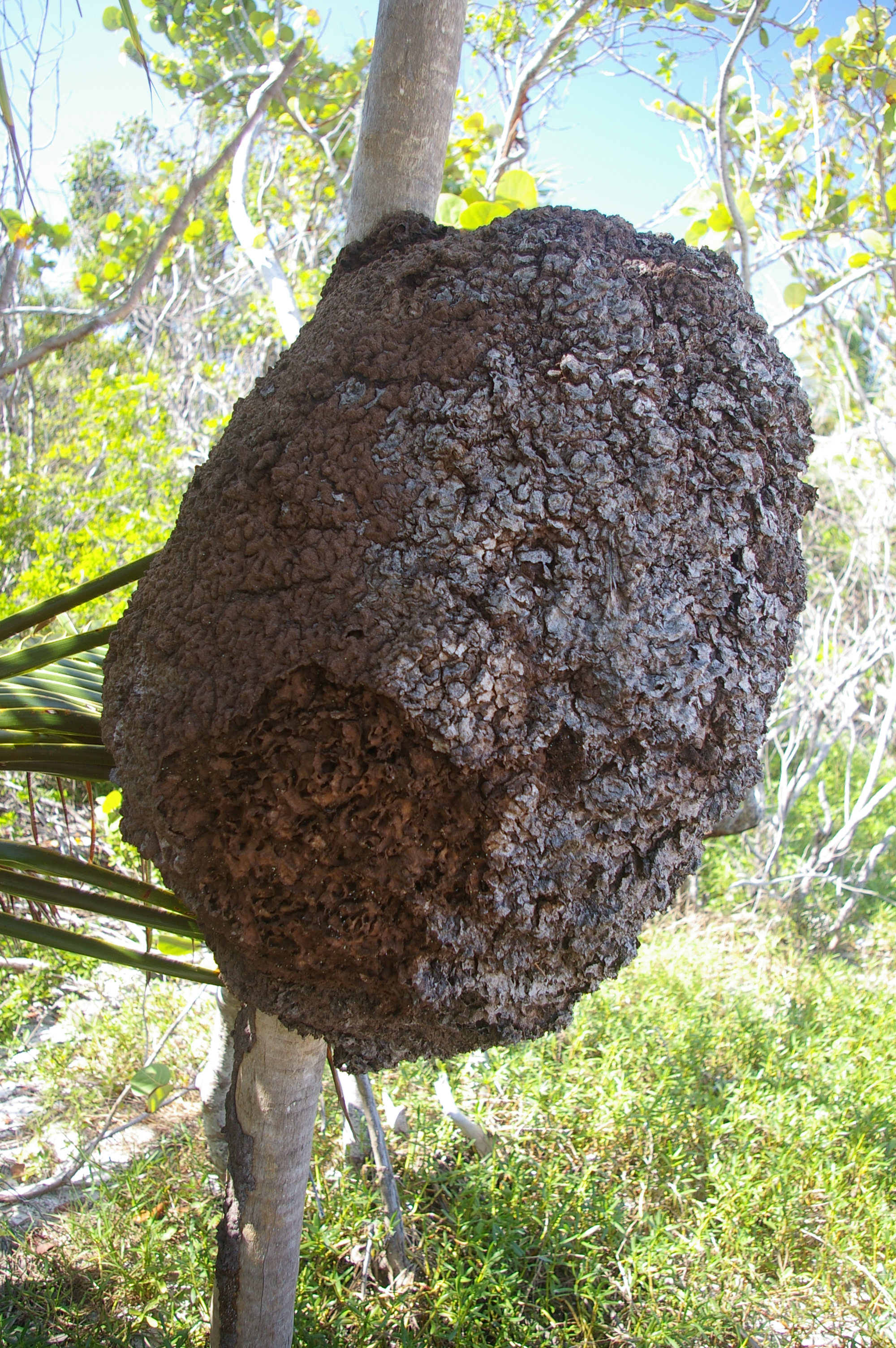
I found loads of stuff. Apparently, Termites are amazing builders and create all kinds of mounds and nests. They are related to ants, so they are very organized. In Australia, their mounds can be enormous. Check this out to see one of their mounds in action. They also build nests in trees, so they're pretty versatile. Here's an image of a cool nest in Mexico, hanging from a tree so their natural enemies can't reach it (like ant eaters and such).
Although they eat American homes, termites are quite cool. They go underground and find food undetected because they can follow carbon dioxide. This is released when wood starts rotting. But unfortunately, they only eat wood and plants and stuff. So - as it turns out - they won't eat your hand. Not even if you put an awful lot of jam on it.


 Polar bears only hibernate when they're giving birth. They dig a whole in the snow, disappear for three months and live off their fat reserves. The problem is that the more they lose their natural environment because of climate change, the less they can eat and build up fat for giving birth. The result is less and less polar bear cubs! I thought that was quite depressing ... It's "Raise your Paw for Polar Bears" for Greenpeace this week, so maybe we can all help via #raiseyourpaw.